
Around here, we say “Caddo” all the time.
Caddo Parish. Caddo Lake. Caddo schools. Caddo Street. It is stitched so tightly into the map of Northwest Louisiana that the word can start to feel like simple geography.
It is not.
The parish is named for the Caddo people, whose history in the Red River region reaches back well before Shreveport, Louisiana or the United States existed. November is Native American Heritage Month, which makes this a good time to pause and remember that the name on our signs belongs to a living people and culture—not just a chapter in a history book. Louisiana’s official Caddo Parish profile National Native American Heritage Month
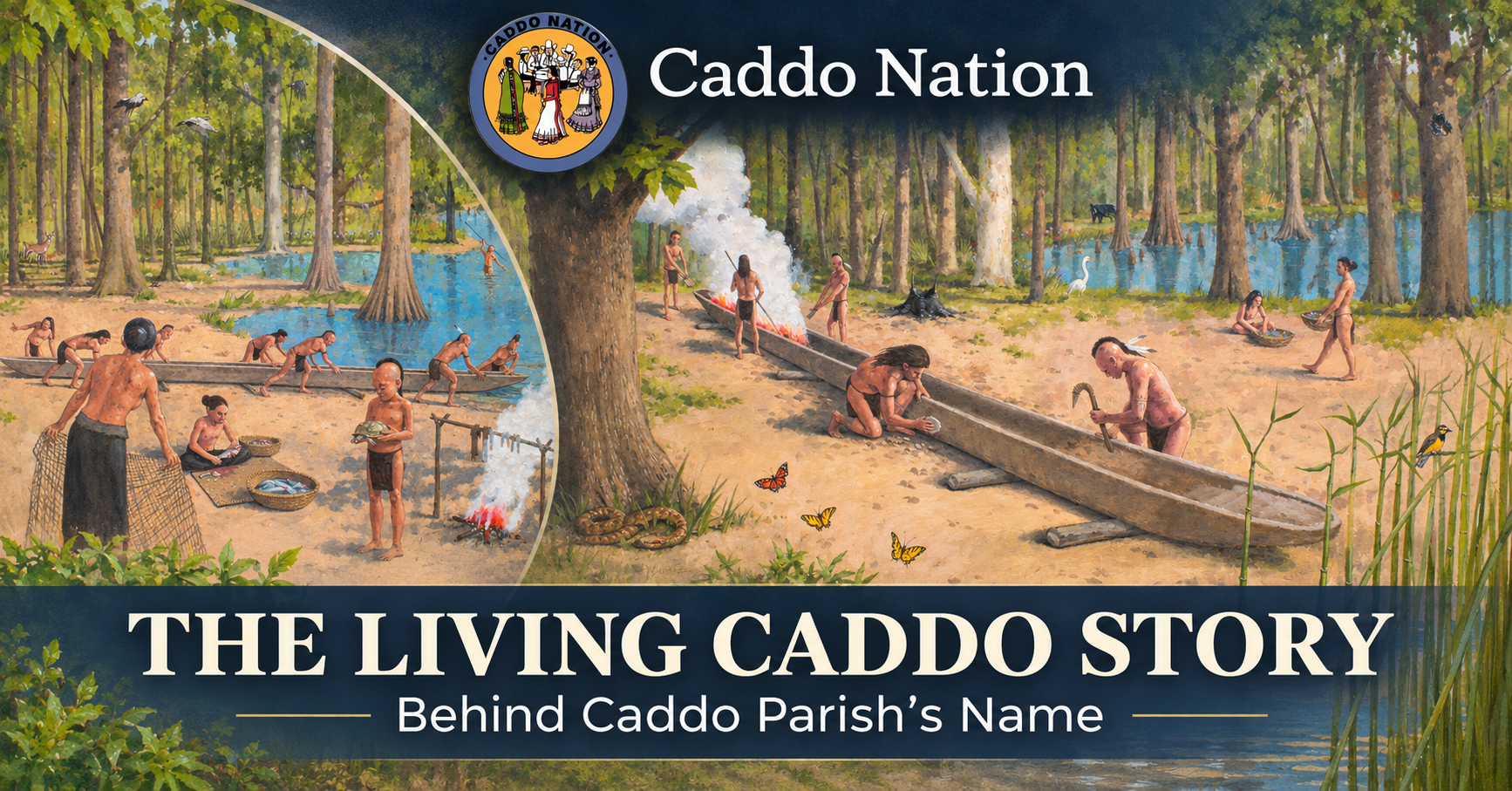
According to the National Park Service, Caddo communities developed across river systems that include the Red, Sabine, Angelina and Neches. By the time of European contact, closely affiliated Caddo groups lived across what is now northwestern Louisiana, East Texas, southwestern Arkansas and southeastern Oklahoma. Agriculture was central, including corn, beans, squash and pumpkins, and the region’s rivers helped support long-lasting communities and trade. National Park Service: Early Caddo History
Louisiana’s Division of Archaeology says Caddo people have inhabited Northwest Louisiana and surrounding areas since at least the 900s CE. Traditional villages included homes and gardens along bayous and in the Red River floodplain, as well as communities on higher ground. People farmed, hunted, fished, traveled by canoe and made distinctive pottery and other tools and objects. Louisiana Division of Archaeology: Caddo Canoe and village life
Those details matter because they replace a vague idea of “people who were here first” with something more real: families, farms, engineering, art, travel, trade and communities shaped by the same rivers and soils that still shape Northwest Louisiana.
The story also includes removal and loss. In the 1830s, Caddo leaders ceded land in what is now Northwest Louisiana, and Caddo people were forced westward through a series of relocations. That history should not be softened into a neat transition from one set of place names to another.
But it should not end there, either.
Today, the Caddo Nation is headquartered in Binger, Oklahoma, and its official communications describe a sovereign nation of more than 7,000 tribal citizens. The Nation supports language preservation, cultural gatherings, historic preservation and current programs for its citizens. Its culture page describes songs, drumming and dances as living traditions carried forward by Caddo people and organizations today. Caddo Nation official website Caddo Nation cultural events and organizations
That present tense is important.
Too often, local history talks about Indigenous people only in the past tense, as if Native history ended when a city plat began. A better understanding of place recognizes both truths: the Caddo people were foundational to this region, and Caddo people are still here as a nation, families and culture.
What does that have to do with a community and real-estate blog? Everything, if we believe a place is more than a list of buildings and sale prices.
Land has layers. Neighborhoods have stories. The names we repeat every day can connect us to those layers—or hide them in plain sight. Learning where “Caddo” comes from does not make Northwest Louisiana less ours. It helps us understand more honestly what we have inherited and whom we should acknowledge.
This month, take a few minutes to explore the Caddo Nation’s own website and the National Park Service’s Caddo history series. If you have children or grandchildren, show them that Caddo is not only the name printed on a school bus or parish map.
It is the name of a living people whose story is still being written.