
Bossier City: The Other Half of the Red River Story
When people talk about the origins of northwest Louisiana, the spotlight usually falls on Shreveport.
After all, the city owes its existence to Captain Henry Miller Shreve, whose efforts to remove the legendary Great Raft—a massive logjam that clogged the Red River for more than 150 miles—opened the region to navigation, commerce, and settlement during the 1830s.
But across the river lies another community whose story is deeply intertwined with Shreveport's rise.
That community is Bossier City.
Who Was Pierre Evariste John Baptiste Bossier?
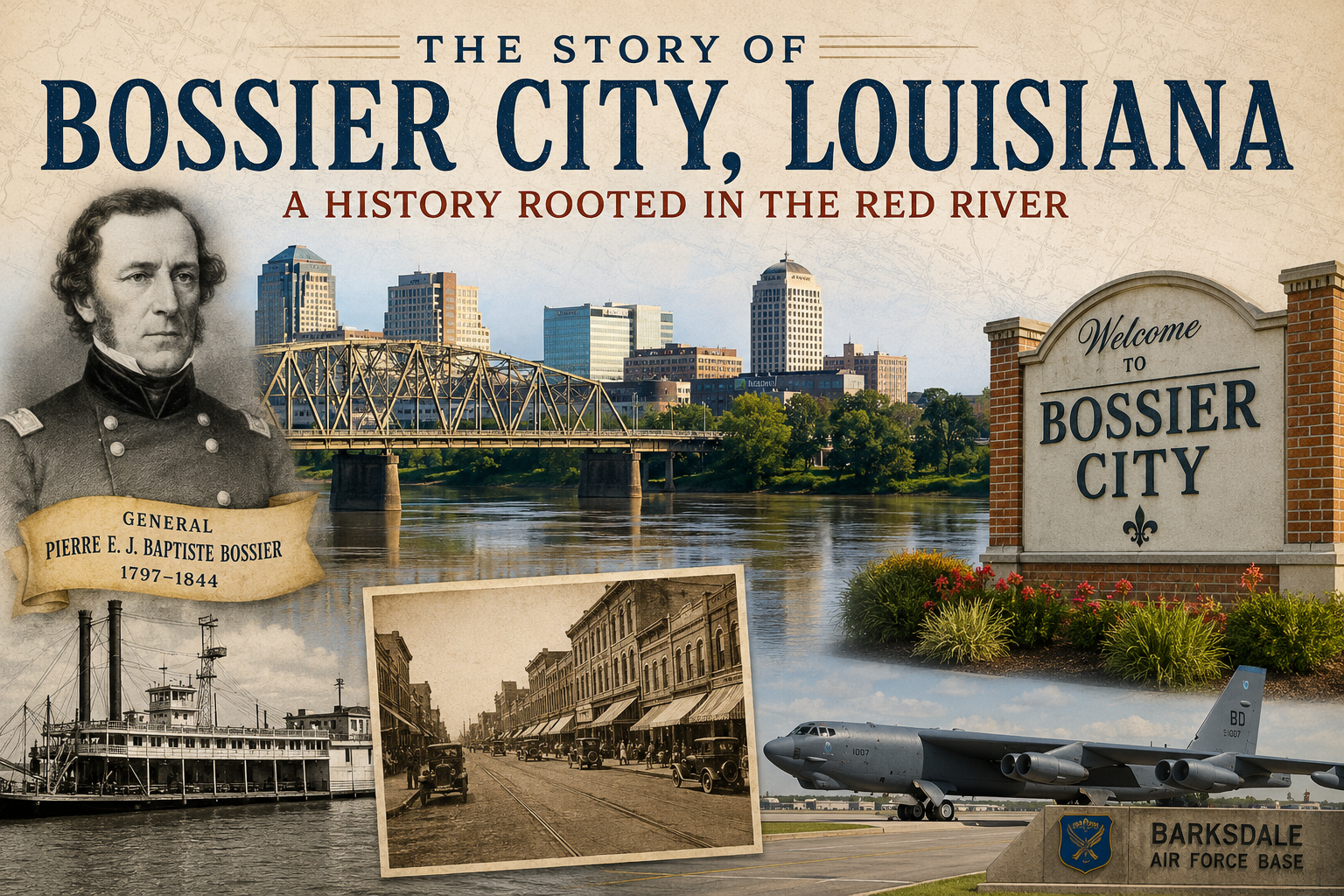
Bossier City and Bossier Parish were both named in honor of General Pierre Evariste John Baptiste Bossier (1797–1844), a prominent Louisiana figure who served in numerous leadership roles during his lifetime.
Born in Natchitoches, Bossier was a planter, judge, state senator, and militia general. He became one of the most influential political leaders in north Louisiana during the early years of statehood. His service in public office and his contributions to the development of the region earned him widespread respect, leading Louisiana legislators to name Bossier Parish in his honor when the parish was created in 1843.
The city that would later become Bossier City ultimately inherited the parish's name.
Before There Was a Bossier City
Long before Bossier City existed, the eastern bank of the Red River opposite Shreveport was largely rural land consisting of plantations, farms, and scattered settlements.
The area was strategically important because it sat directly across from one of the most important transportation hubs developing in north Louisiana.
As Shreveport grew into a commercial center after the Red River was opened to navigation, economic activity naturally began spreading across the river.
Ferries transported people, livestock, wagons, and goods between the two sides. Trade routes expanded. Landowners recognized the area's potential for growth.
The story of Bossier City was already beginning long before the city officially existed.
The Formation of Bossier City
The community was originally known as Bossier Town.
In the late 19th century, development accelerated as railroads expanded across the South and transportation infrastructure improved throughout the Red River Valley.
The arrival of rail connections made the east side of the river increasingly attractive for commerce and industry. Businesses, warehouses, transportation companies, and residential neighborhoods began to emerge.
In 1907, Bossier City was officially incorporated.
While Shreveport had developed first because of its river access, Bossier City's growth was fueled by many of the same forces: transportation, trade, and strategic location.
The two communities increasingly functioned as partners in the economic development of the region.
The Military Connection
One of the most significant chapters in Bossier City's history came during the 20th century with the establishment of Barksdale Field in 1933, later renamed Barksdale Air Force Base.
The installation transformed the city's economy and identity.
Barksdale became one of the nation's most important military bases and remains home to the 2nd Bomb Wing and Global Strike Command. The base brought thousands of military personnel and their families to the region while generating economic activity that continues to shape both Bossier City and Shreveport today.
Few events have had a greater impact on Bossier City's growth than the arrival of Barksdale.
A Shared History Across the River
It is easy to think of Shreveport and Bossier City as separate places.
In reality, their histories are inseparable.
Shreveport emerged because the Red River was opened.
Bossier City grew because of the opportunities that opening created.
Commerce crossed the river. Railroads crossed the river. Bridges crossed the river. Families crossed the river.
Over time, two cities developed, but they remained connected economically, culturally, and geographically.
Today, the Shreveport-Bossier metropolitan area functions as a single regional economy with more than 390,000 residents.
The Story Continues
Communities do not appear overnight.
They are built over generations through geography, infrastructure, leadership, investment, and the willingness of people to believe in a place before its future is certain.
The story of Bossier City is a reminder that the growth of northwest Louisiana was never the work of a single person or a single community.
It was the result of countless individuals—from Henry Miller Shreve clearing the Red River, to Pierre E. Bossier serving Louisiana's early government, to the entrepreneurs, farmers, railroad builders, military personnel, and residents who followed.
Their efforts shaped the region we know today.
And like every good community story, the next chapter is still being written.