
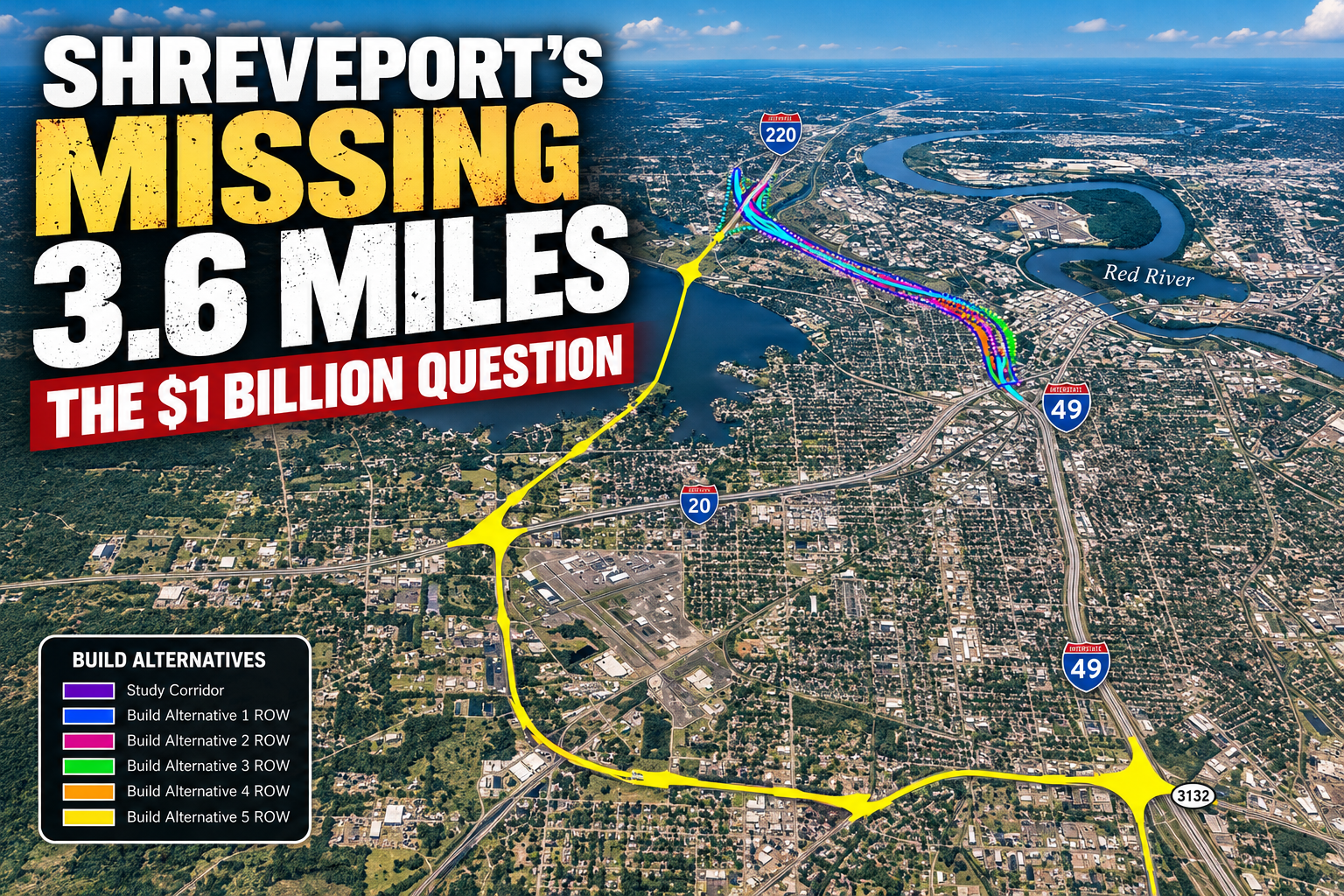
Three-point-six miles. That's it.
You can drive that distance in about five minutes on a good day. But in Shreveport, those 3.6 miles have generated decades of debate, countless meetings, environmental studies, and a potential price tag approaching $1 billion.
Welcome to the ongoing saga of the I-49 Inner City Connector.
If you've lived in Shreveport for any length of time, you've probably heard about this project. You may have strong opinions about it. Or perhaps you've wondered why Interstate 49 seems to disappear in the middle of town, only to reappear farther north.
Well, there's a new development. And while we're not exactly breaking out the orange construction barrels, the project has taken another step forward.
Here's what's happening, why it matters, and what it could mean for Shreveport.
First, What's Missing?
Interstate 49 currently has a gap through Shreveport.
The proposed Inner City Connector would create approximately 3.6 miles of interstate highway linking I-49 near its interchange with I-20 to I-49 North near I-220.
Sounds simple enough, right?
Not quite.
Building an interstate through an established city isn't like laying pavement across an empty field. There are homes, businesses, historic neighborhoods, infrastructure, environmental considerations, and people whose lives could be affected.
And that's where things get complicated.
Supporters argue that completing I-49 would improve regional connectivity, provide a more direct interstate route, and potentially strengthen economic development opportunities.
Opponents and concerned residents question the cost, potential displacement, effects on historic neighborhoods, and whether the benefits justify the investment.
Both sides have questions worth answering.
So, What's the Latest News?
According to an October 22 report from the Bossier Press-Tribune, project officials resubmitted the Draft Environmental Impact Statement (EIS) to federal reviewers on October 20 after addressing comments.
Now, before anyone starts celebrating—or panicking—let's explain what that actually means.
An Environmental Impact Statement is essentially a detailed examination of how a major project could affect the surrounding community.
Think of it as the highway project's report card, except the subjects include traffic, neighborhoods, historic properties, noise, environmental conditions, and potential alternatives.
The Federal Highway Administration must clear the draft for public circulation before the formal review process can begin.
And here's the important part: That clearance is not the same thing as approving construction.
As of the October 30 project update, no public hearing had been scheduled.
In other words, we're moving through the paperwork, not moving dirt.
Let's Talk About That Billion-Dollar Price Tag
Here's where things get particularly interesting.
The Louisiana Department of Transportation and Development's reported estimate for the connector is somewhere between $800 million and $1 billion.
For 3.6 miles.
I'll save you the calculator.
That's approximately $222 million to $278 million per mile.
Of course, we're not talking about an ordinary stretch of asphalt. Interstate construction through an urban area can involve bridges, interchanges, utility relocation, property acquisition, engineering, environmental mitigation, and other major expenses.
Still, that's a number that deserves serious attention.
According to the October report, more than $150 million in state funding has been secured.
That's substantial, but it leaves a significant funding gap.
And even if federal officials ultimately approve the project, that approval doesn't automatically come with a billion-dollar check.
The remaining funding would still need to be identified and secured.
Bottom line: The project isn't fully funded, and no construction start date has been announced.
What About the Neighborhoods?
This may be the most important part of the entire conversation.
Shreveport has neighborhoods with deep histories, established communities, and generations of families who have called them home.
An interstate project of this magnitude raises legitimate questions about property values, neighborhood connectivity, historic preservation, traffic patterns, and quality of life.
For homeowners and business owners near the proposed corridor, the concerns can be particularly personal.
Will my property be affected?
Will traffic patterns change?
What happens to neighborhood access?
Could nearby homes experience additional noise?
What protections would be available for affected property owners?
These aren't hypothetical questions for the people who live and work in these areas.
They're exactly the kinds of issues the environmental review process is intended to examine.
And as someone who believes strongly in the importance of preserving and revitalizing Shreveport's established neighborhoods, I think those questions deserve thoughtful, documented answers.
Progress and preservation shouldn't automatically be treated as opposing goals.
But finding the right balance requires more than a colorful map and a construction estimate.
Here's What Happens Next
Before the project can move toward construction, several important steps remain.
First, federal reviewers must clear the Draft Environmental Impact Statement for public circulation.
Once the required Notice of Availability is published, the formal public-comment period can begin.
The reported review process includes a 45-day public-comment period, with a public hearing held after the document has been available for at least 30 days. The comment period must also remain open for at least 10 days following the hearing.
That gives residents, business owners, neighborhood organizations, and other interested parties an opportunity to examine the proposal and provide feedback.
Afterward, the project team would review comments, prepare a Final Environmental Impact Statement, and seek a federal Record of Decision.
And even then, additional design work, funding decisions, and other steps would remain before construction could begin.
So, no, we're not likely to wake up tomorrow to bulldozers building an interstate through downtown.
The Bigger Question: What Kind of Shreveport Are We Building?
This is where the conversation becomes bigger than 3.6 miles of highway.
Shreveport is a city with tremendous potential.
We're seeing renewed interest in downtown, investments in established neighborhoods, and ongoing conversations about how to attract businesses, residents, and economic opportunities.
Transportation infrastructure is certainly part of that equation.
But so are strong neighborhoods, historic preservation, housing, and responsible use of public money.
The I-49 Connector debate brings all those issues together.
Could completing the interstate improve regional transportation and economic development?
Possibly.
Could the project create challenges for existing neighborhoods and property owners?
That's precisely why the environmental analysis matters.
And is an investment approaching $1 billion the best way to accomplish the region's transportation goals?
That's a question taxpayers deserve to see thoroughly examined.
My Take: Let's See the Details
I'm all for improvements that make Shreveport a stronger, more connected, and more attractive place to live and do business.
But a project of this magnitude deserves more than a simple thumbs-up or thumbs-down.
It deserves careful study, transparency, and meaningful public participation.
The latest development is encouraging for those who want the planning process to move forward, but it doesn't settle the larger debate.
The route isn't finally approved. The project isn't fully funded. And construction isn't around the corner.
What we may soon have is something much more useful: detailed information that allows the public to evaluate the proposal.
When the Draft Environmental Impact Statement becomes available, I encourage residents to read it, ask questions, and participate in the public-comment process.
You can follow developments through the official I-49 Inner City Connector website and its public involvement page.
For additional background, read the October 22 Bossier Press-Tribune report.
After all, 3.6 miles may not sound like much. But the decisions surrounding those miles could influence Shreveport for generations.
Now I'm Curious...
What do you think Shreveport should do about the missing stretch of I-49?
Complete the interstate, explore alternatives, or put the money toward other transportation priorities?
I'd love to hear your thoughts.