
Another North Louisiana Site Is Ready for Business: Why the Moore Site Certification Matters
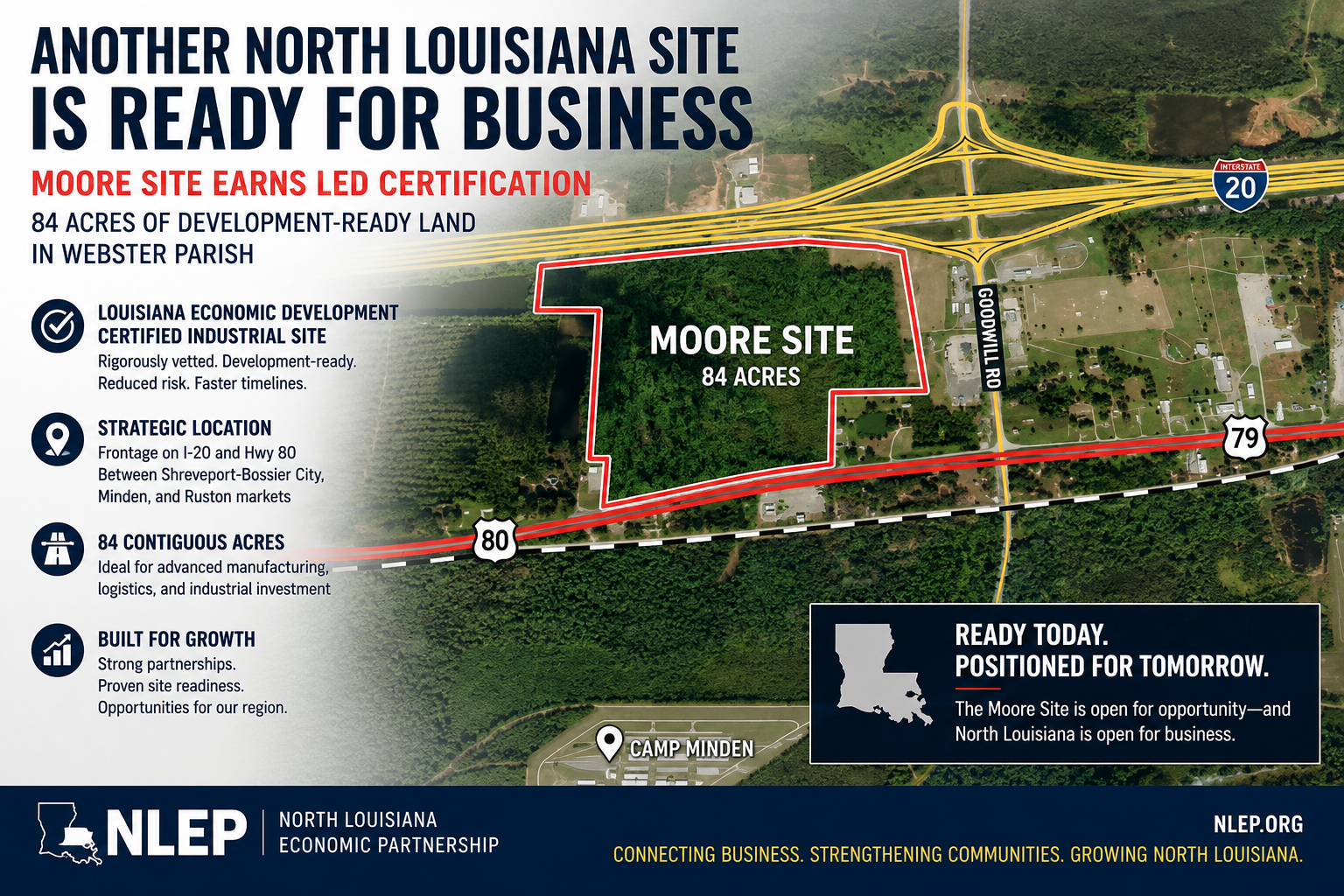
When companies go looking for a place to build a new manufacturing plant, distribution center, or industrial facility, communities don't get much time to make their case.
Increasingly, the question isn't simply, "Do you have available land?"
It's "Do you have land that's ready?"
North Louisiana just added another property to that list.
The Moore Site in Webster Parish has officially earned designation as a Louisiana Economic Development Certified Industrial Site, according to an August 11 announcement from the North Louisiana Economic Partnership (NLEP).
The 84-acre property sits along Interstate 20 and Highway 80, strategically positioned between the Shreveport-Bossier City, Minden, and Ruston markets.
And while "certified industrial site" may sound like another economic-development designation, it's actually an important piece of the region's effort to compete for new employers, jobs, and investment.
What Does an LED Certified Site Actually Mean?
Imagine you're a company considering spending tens—or even hundreds—of millions of dollars on a new facility.
Finding a piece of vacant land isn't particularly difficult.
Finding one where many of the major questions have already been answered is considerably more valuable.
Louisiana Economic Development's Certified Sites Program requires properties to undergo extensive evaluation and due diligence involving issues such as ownership, environmental conditions, utilities, transportation access, development constraints, and other factors important to major industrial projects.
In other words, companies aren't starting with a blank sheet of paper.
A significant amount of homework has already been done.
That reduces uncertainty for companies and can shorten the amount of time required to move from site selection to actual development.
And in modern economic development, speed matters.
Location, Location, Location—Even for Industrial Real Estate
The Moore Site has another obvious advantage: Interstate 20.
The property includes approximately 84 contiguous acres with frontage and access along I-20 to the north and historic Highway 80 to the south.
That places it along one of North Louisiana's most important transportation corridors.
Interstate 20 connects the property west toward Minden, Bossier City, Shreveport and Texas and east toward Ruston, Monroe and ultimately the broader southeastern United States.
For manufacturers, logistics companies and other industrial users moving people, materials and finished products, interstate accessibility can be one of the first boxes on the site-selection checklist.
NLEP President and CEO Justyn Dixon described the combination of interstate frontage and site certification as particularly valuable.
“Companies evaluating North Louisiana can move forward with confidence knowing this site is development-ready, strategically positioned between the Shreveport-Bossier City, Minden, and Ruston markets, and supported by partners committed to helping projects succeed.”
That's an important distinction.
Economic development isn't simply about having property available when the phone rings.
It's about having property ready before the phone rings.
The Competition for Industrial Projects Starts Years in Advance
When we hear that Louisiana is competing with Texas, Arkansas, Mississippi, Alabama, Georgia, Tennessee or another state for a major project, we usually hear about it near the end of the process.
But much of that competition happened long before the public ever knew a company was looking.
Sites were identified.
Utilities were evaluated.
Environmental questions were investigated.
Transportation networks were studied.
Workforce availability was analyzed.
Incentives were compared.
Potential development problems were identified.
By the time a company announces its shortlist, communities that haven't done their homework may already be out of the running.
Louisiana Economic Development Chief Economic Competitiveness Officer Ileana Ledet summed it up well:
“Winning projects begins long before a company ever visits a site.”
That's exactly why certified sites matter.
They give Louisiana and regional economic-development organizations something tangible to put in front of site selectors.
Instead of saying, "We think this property could work," they can provide documented information showing why it could work.
A Property With Industrial—and Potential Commercial—Possibilities
The Moore property is owned by ELM Family Investments, LLC, whose Roy Moore noted that its location gives the tract possibilities beyond traditional industrial development.
With I-20 along the northern side and Highway 80 along the south, the property could potentially accommodate both industrial and commercial applications depending upon the eventual project.
Moore said the due diligence involved in receiving LED certification gives the ownership additional confidence as the property is marketed.
That matters because successful economic development usually requires cooperation among private property owners, utilities, parish and municipal governments, state agencies, and regional organizations.
The Moore Site certification involved precisely that kind of partnership.
NLEP, Louisiana Economic Development, the Webster Parish Police Jury, Entergy Louisiana, property ownership and other local partners all played roles in positioning the site for future investment.
Why Webster Parish Benefits
For Webster Parish, the goal is straightforward: put another serious contender on the table when companies consider North Louisiana.
Webster Parish Police Jury President Jon Bonsall called the certification a milestone that strengthens the parish's competitive position for new business and industrial investment.
The ultimate objective isn't the certification itself.
It's what could eventually happen because of it.
A successful industrial recruitment project can mean construction spending, permanent jobs, additional payroll circulating through the local economy, new customers for existing businesses, increased demand for suppliers and services, and additional private investment.
There are never guarantees in economic development. A certified site doesn't mean a factory or distribution center will suddenly appear next month.
It means something arguably more important at this stage:
Webster Parish gets to compete.
Another Piece of a Bigger North Louisiana Strategy
The Moore Site also shouldn't be viewed in isolation.
NLEP has been steadily working to expand North Louisiana's inventory of sites capable of competing for industrial development.
That's important because companies aren't all looking for the same thing.
One prospect might need 20 acres.
Another might need 100.
Another could require rail access.
Another may prioritize interstate frontage.
Some need enormous amounts of electricity, natural gas or water.
Others need immediate proximity to population centers or particular workforce skills.
The larger and more diverse the region's portfolio of vetted, development-ready properties becomes, the greater the likelihood that North Louisiana has something that fits when an opportunity appears.
It's a little like having inventory in real estate.
You can't sell what you don't have.
And in economic development, you can't seriously compete for a project requiring a development-ready site if you're only beginning the due-diligence process after the company comes calling.
Preparing Today for the Jobs of Tomorrow
There probably won't be a ribbon cutting at the Moore Site tomorrow.
That's not really the point.
Economic development often involves doing unglamorous work years before the payoff arrives.
It's surveys.
Environmental studies.
Utility research.
Infrastructure planning.
Property documentation.
Transportation analysis.
And countless other details that most people will never see.
But when a company says it wants to invest millions of dollars and create jobs—and wants to move quickly—that preparation suddenly becomes incredibly valuable.
The Moore Site's LED Certified Industrial Site designation means another 84 acres along one of North Louisiana's most important transportation corridors has gone through that preparation.
Now comes the next challenge:
Getting the right company to notice it.