
Shreveport Forward Tackles One of the City's Biggest Challenges: Housing
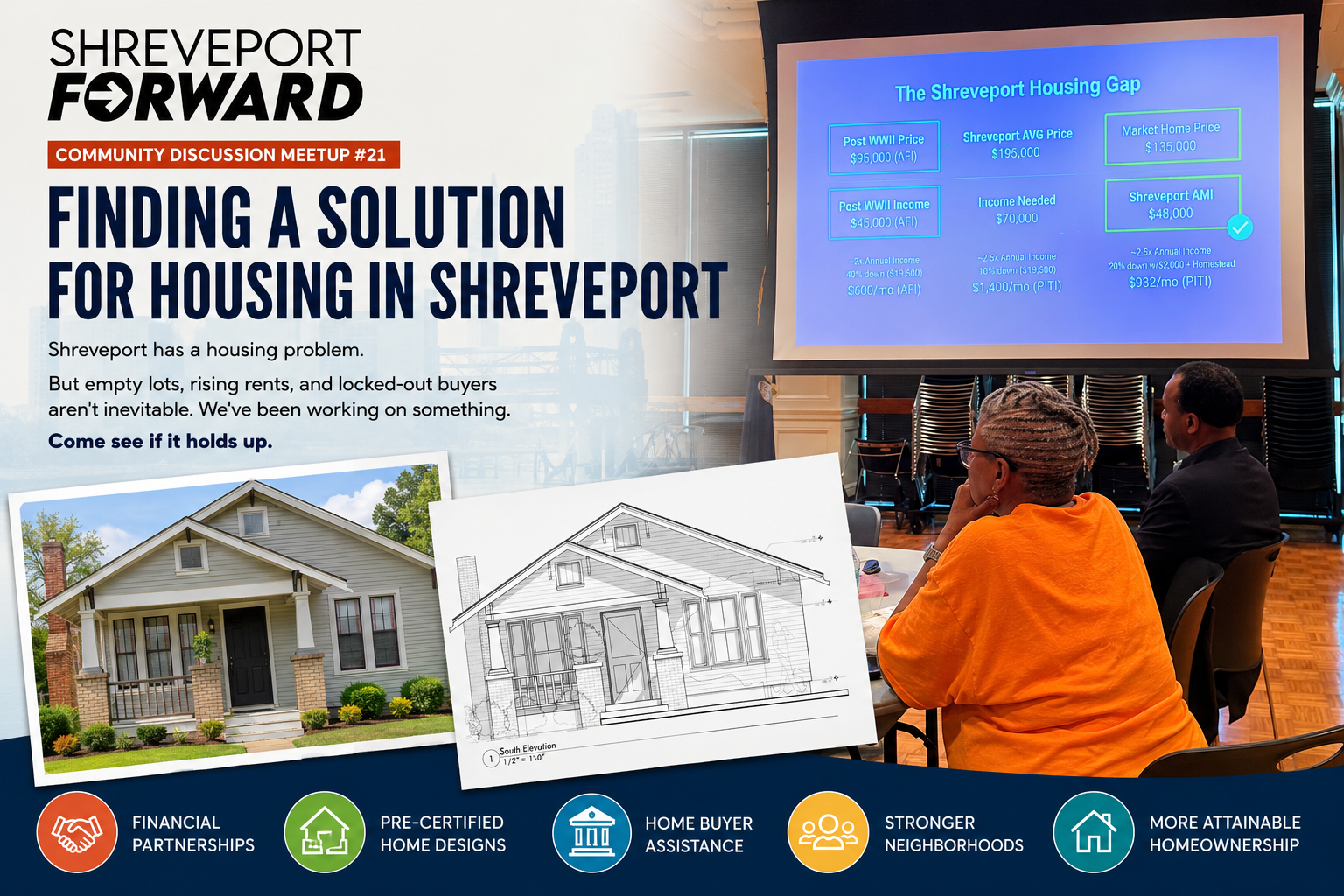
On a recent Saturday morning, community leaders, housing advocates, developers, bankers, architects, and interested residents gathered at the LSUS University Center for the 21st Shreveport Forward Community Discussion Meetup to tackle a challenge that affects nearly every corner of the city: housing affordability and homeownership.
The premise was simple.
Shreveport has thousands of vacant lots, neighborhoods in need of reinvestment, rising housing costs, and many families who earn enough to afford a home—but not enough to build one under today's construction costs.
The meeting wasn't simply about identifying the problem. It focused on creating a repeatable solution.
The Housing Gap
One of the most eye-opening discussions centered around what organizers called The Shreveport Housing Gap.
While the average home sale price in Shreveport now sits around $195,000, the average cost to build a new home is approximately $240,000 or more.
For many first-time buyers, that's simply out of reach.
Presenters illustrated how today's buyers often need household incomes approaching $70,000 annually to comfortably purchase the average home, while Shreveport's Area Median Income is closer to $48,000.
The result?
Many working families remain renters despite having stable employment.
Making Homeownership Possible
Rather than accepting this reality, Shreveport Forward is working on ways to reduce the barriers.
Among the strategies discussed were leveraging existing assistance programs, including:
Louisiana Housing Corporation's Soft Second Mortgage Program
Home-buyer's Assistance Program Participation Initiative (HAPPI)
Homestead Exemption benefits
Partnerships with local lenders to create affordable financing products
The goal is to bridge the affordability gap so families earning moderate incomes can purchase newly constructed homes instead of being priced out of the market.
A Smarter Way to Build
Perhaps the most innovative concept presented was the development of a pre-certification process for home designs.
Instead of submitting every new house through lengthy architectural and permitting reviews individually, organizers envision a library of pre-approved home designs that already meet neighborhood standards.
That means:
Faster permitting
Lower design costs
More predictable construction timelines
Consistent architectural quality
Easier infill development on vacant lots
By removing unnecessary delays and uncertainty, builders could construct quality homes more efficiently while maintaining compatibility with surrounding neighborhoods.
Creating a Repeatable System
The presentation emphasized that solving Shreveport's housing shortage isn't about building a few homes.
It's about creating a system.
Current priorities include:
Working with local banks to develop financing products
Improving financial education for future homeowners
Partnering with architects on neighborhood-appropriate designs
Coordinating with the Metropolitan Planning Commission and Historic Preservation Commission on pre-certification standards
Identifying suitable infill lots throughout the city
Developing demonstration homes that prove the model works
Rather than approaching each project individually, the objective is to create a process that can be repeated across neighborhoods throughout Shreveport.
Why Homeownership Matters
The discussion closed by focusing on something larger than real estate.
Homeownership creates community stability.
Research consistently shows it can contribute to:
Greater financial security for families
Increased neighborhood investment
Higher property values
Stronger community pride
Improved public safety
Increased local tax revenue that benefits city services
For Shreveport, increasing homeownership isn't simply about building houses—it is about strengthening neighborhoods and creating long-term economic growth.
A Collaborative Effort
What made Saturday's meeting encouraging was the broad range of participants involved.
This isn't a conversation being led solely by developers or government officials. Financial institutions, architects, community organizations, planners, housing advocates, and residents are all being invited to help shape practical solutions.
No single organization can solve Shreveport's housing challenges alone.
But by combining financial assistance, streamlined permitting, thoughtful design, and strategic neighborhood investment, Shreveport Forward hopes to build a model that can be replicated throughout the city.
The initiative is still evolving, but the direction is clear: make quality homeownership more attainable while helping vacant lots become productive parts of thriving neighborhoods once again.