
The Good, the Hard and the Hopeful: What Community Counts 2026 Says About Shreveport-Bossier
Every community has two versions of itself.
There is the place we experience personally—the traffic we sit in, the school our children attend, the neighborhood we love and the restaurant we insist everyone try.
Then there is the place described by the numbers.
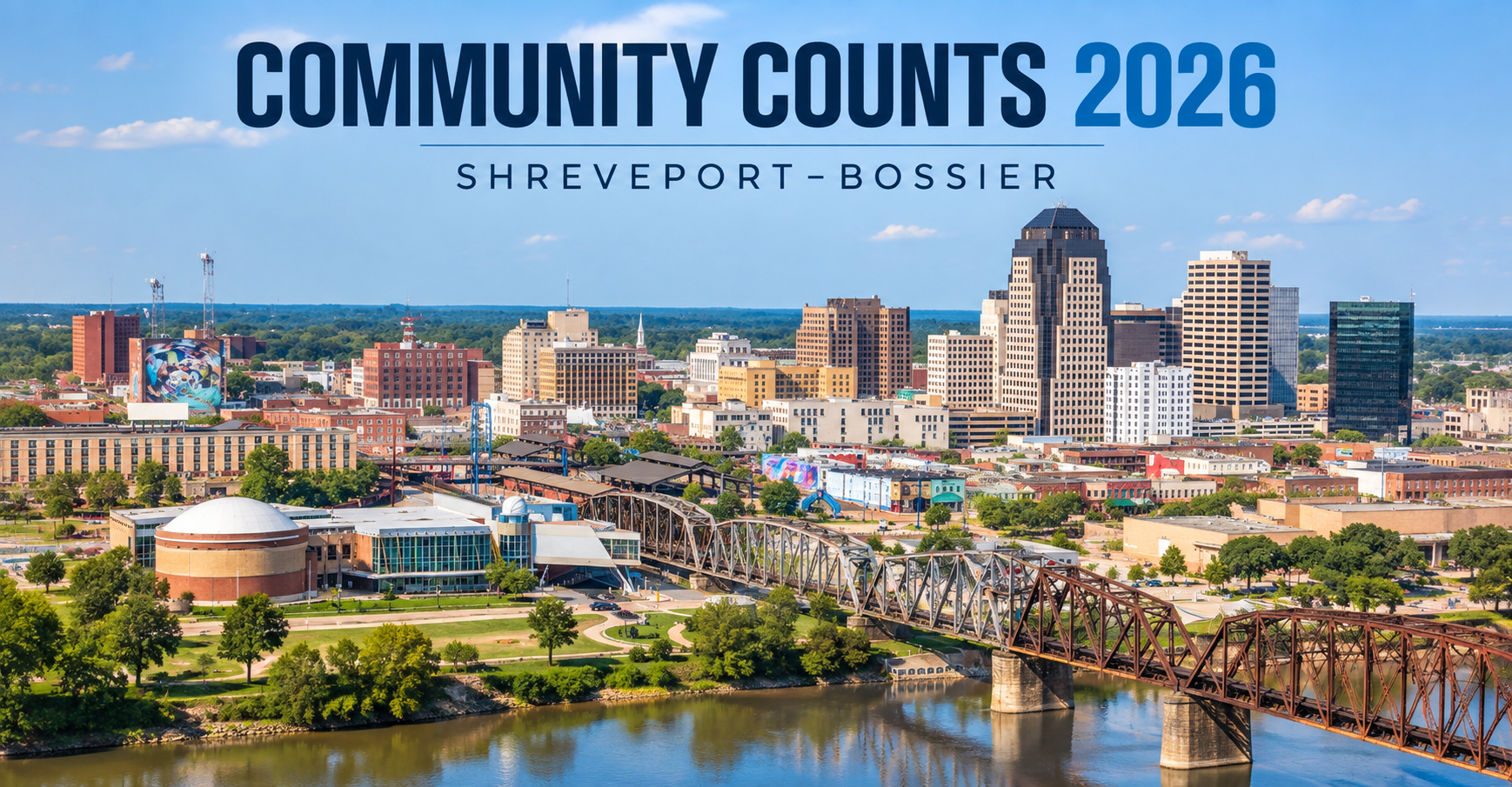
The Community Foundation of North Louisiana has released its 2026 Community Counts report, offering a data-driven look at how the Shreveport-Bossier metropolitan area is doing across population, economic well-being, education, health, social conditions and the physical environment.
The report uses 41 indicators and compares Shreveport-Bossier with 10 peer communities.
It is not a cheerleading brochure, and it is not a list of everything going wrong.
It is more useful than either of those because it shows progress and problems on the same page.
Let’s start with some encouraging news.
Shreveport-Bossier ranked fourth among its peer communities in the percentage of 3- and 4-year-olds enrolled in school, at 48.9 percent. The region also placed among the top four for per-capita personal income, growth in per-capita real gross domestic product and air quality.
Median household income increased by more than $2,600 from 2023 to 2024.
Air quality improved as well. The region moved from ninth to fourth among the comparison communities for median Air Quality Index. In 2025, air quality was rated moderate or worse on 31 percent of days, down from 50 percent in 2024.
High school graduation rates have also climbed by more than 10 percentage points over the last decade.
Those are not small accomplishments.
They suggest that Northwest Louisiana has real strengths to build on: better outcomes in several important categories, growing economic productivity and measurable improvement in areas that affect daily quality of life.
But the report also shows where the numbers become much harder.
Community Counts found that 28 percent of local families with children younger than 5 live below the poverty threshold.
It also reported that 11.9 percent of residents ages 16 to 19 are neither enrolled in school, employed nor participating in the labor force. In research language, that group may be described as “idle.” In real life, it represents young people at risk of entering adulthood without a clear connection to school, training or work.
The report also found that 7.5 percent of the metropolitan population lacks health insurance.
Those numbers deserve attention—not because they erase the progress, but because they help identify where progress is most urgently needed.
There is another important caution when reading the report: most of the data in Community Counts 2026 was collected in 2024. That is normal for large public datasets, which take time to assemble and verify, but it means the report is best understood as a well-researched snapshot rather than a live dashboard of October 2026.
It can show us where we stood and how we compare. It cannot, by itself, explain every cause or tell us exactly what has changed since then.
The Community Foundation makes that distinction clear. Community Counts is designed to help residents, nonprofit organizations and local leaders monitor trends. It does not claim that a single statistic explains the whole community.
That is the right way to read it.
A ranking is not destiny. A good number is not permission to become comfortable, and a bad number is not proof that nothing is working.
The real value comes from using the data to ask better questions.
Why are early-school enrollment numbers comparatively strong while so many families with very young children remain below the poverty line?
What helped graduation rates improve, and how can those lessons reach teenagers who are disconnected from both education and employment?
How can economic-development wins translate into wider household stability, career training and opportunity?
Those are not questions one organization can answer alone.
The Community Foundation is already directing much of its grantmaking toward the issues identified in the report. In April 2026, it awarded $4.1 million in competitive grants to 69 nonprofit organizations, with more than 80 percent of that funding going to programs addressing concerns such as poverty, educational attainment and health.
That is one response. Schools, employers, local governments, churches, neighborhood groups and families all have pieces of the larger puzzle.
Community pride should be strong enough to hold two truths at the same time.
Shreveport-Bossier is making progress in several meaningful areas.
Shreveport-Bossier still has neighbors who are not sharing equally in that progress.
The Community Counts report does not hand us a simple verdict on the region.
It gives us something better: a clearer picture of where we are, what is improving and where our attention could make the greatest difference next.
The numbers are worth reading.
What we decide to do with them is the real story.