
The New Jimmie Davis Bridge Is Getting Its Driving Surface—and the Old One Is Turning Blue
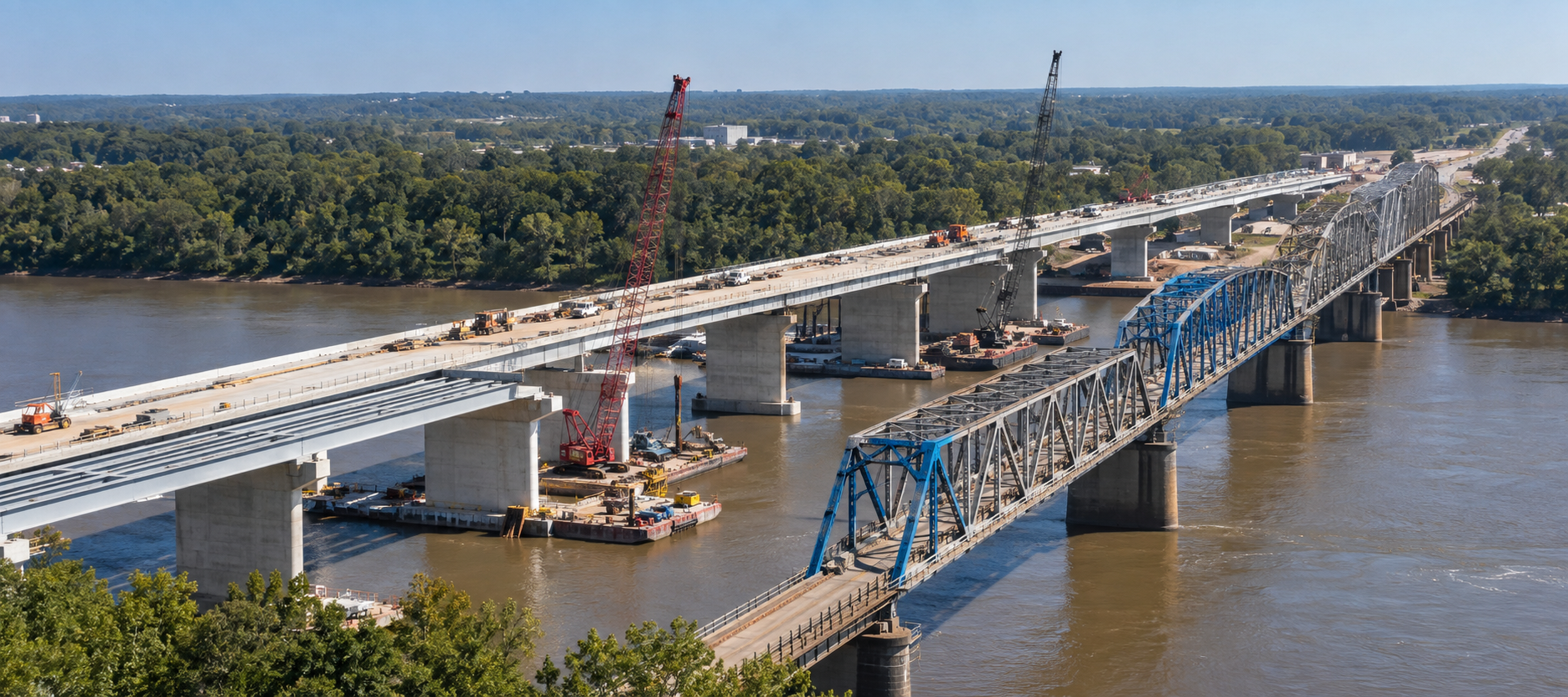
For the last couple of years, most of us have crossed the Jimmie Davis Bridge construction zone with the same basic thought:
That is a lot of equipment.
Now the project is reaching the stage where the future is becoming much easier to see.
The Louisiana Department of Transportation and Development says girder installation on the new bridge is complete, meaning the structure is fully connected across the Red River. The next major step is underway: building the bridge deck—the concrete surface vehicles will eventually drive across.
That is a fairly big milestone for a project that is doing much more than replacing two lanes with four.
The $361.7 million project includes a new four-lane bridge just north of the existing Jimmie Davis Bridge, major reconstruction of the LA 511 approaches on both sides of the river, new ramp work and changes intended to improve traffic flow and safety.
And then there is the old bridge.
Instead of tearing down the 1968 structure, the state is rehabilitating it as Louisiana’s first linear park. It is being prepared for walking paths and bicycle lanes that will connect with trail systems in both Caddo and Bossier parishes, including a planned extension to Hamel Memorial Park.
In September, crews removed part of the containment system used during sandblasting and painting. Underneath was the first public glimpse of the bridge’s new blue finish.
It looked less like a piece of aging infrastructure and more like the beginning of a destination.
That may be the most interesting part of the entire project.
Most bridge projects are designed to solve one problem: move vehicles from one side to the other. This one is being asked to do several things at once.
The new bridge is intended to double traffic capacity across the river. The rebuilt approaches are intended to reduce congestion and improve access. The old bridge will get a second life as a place for walking, biking, recreation and river views.
In other words, one crossing will move traffic while the other may finally give people a reason to slow down.
That matters for more than weekend recreation.
Communities become more connected when trails do not simply end at the water. A dedicated bicycle and pedestrian crossing could link the Clyde Fant and Arthur Ray Teague parkway systems in a way the current vehicle bridge never safely could.
It also creates the possibility of a new regional landmark. Plenty of cities have riverfront trails. Far fewer can say they turned a former highway bridge into a linear park.
There is still a lot of work between today’s construction zone and that finished vision.
DOTD currently says the new four-lane bridge is expected to open to traffic in mid-to-late 2027, weather permitting. The complete project, including the linear park, is expected to wrap up in late 2028.
Those dates are projections, not guarantees. Anyone who has ever renovated a house—or watched Louisiana weather rearrange a construction schedule—knows the difference.
The project will also continue to bring lane changes and temporary closures. DOTD issued a late-September notice rescheduling the first bridge-deck pouring operation, but the notice contains conflicting weekday and calendar-date language. Drivers should check Louisiana 511 or the DOTD project page before traveling rather than relying on a screenshot or an older social-media post.
That confusion does not change the larger news: the deck stage is beginning, the new bridge now stretches from one side of the Red River to the other, and the old bridge’s next life is starting to show through in blue.
For years, the Jimmie Davis Bridge project has looked like cranes, barriers and a promise.
Now we can begin to see what that promise may become: more room for cars, safer connections for neighborhoods and businesses, and a completely new way to experience the river that separates—and connects—Shreveport and Bossier City.
That is a lot more exciting than just another bridge.